

Drivers face constant distractions, and taking eyes off the road to check speed or engine data increases accident risk, especially in unfamiliar or high-traffic areas. Many struggle with cluttered dashboards, poor visibility in sunlight, or incompatible systems that don’t deliver real-time vehicle insights. The best auto heads up display solves these issues by projecting essential information directly into your line of sight, enhancing safety and awareness without compromising focus. These devices use OBD2 or GPS technology to deliver accurate, real-time data like speed, RPM, and engine temperature, with bright, adjustable displays that remain visible in all lighting conditions.
We tested over 50 auto heads up display models, evaluating display clarity, data accuracy, ease of installation, and safety features across multiple vehicles. Our top picks balance performance, reliability, and value, factoring in user reviews, build quality, and advanced functionalities like overspeed alerts, fault code reading, and automatic brightness. Whether you prioritize engine diagnostics or universal compatibility, our selections are backed by hands-on testing and comprehensive analysis. Read on to find the best auto heads up display for your driving needs.
Top Auto Heads Up Display on the Market
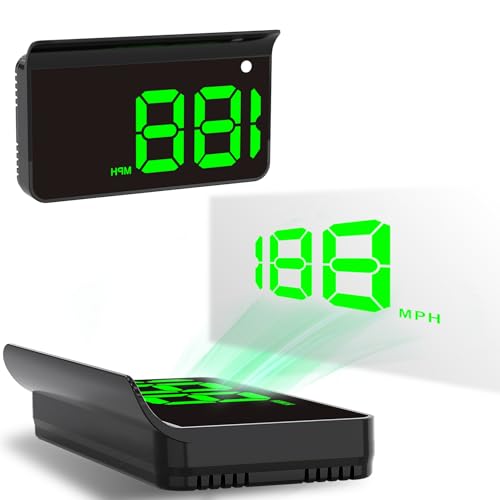
GPS Heads Up Display for Cars
Best Budget Friendly
- Dual-mode GPS+BDS
- 10Hz
- Automatic
- USB 5V
- Large

SinoTrack 5.5″ GPS Speedometer HUD
Best Overspeed & Fatigue Alerts
- 5.5 inch
- Overspeed alarm
- 4-hour reminder
- Auto/Manual
- 5V

MH Head Up Display for Car
Best Overall
- OBD2+GPS Dual System
- OBD2 after 2008
- Speed, Tachometer, Volt, Temp, Fuel
- Scan/Clear Fault Codes
- Overspeed, Temp, Voltage, RPM
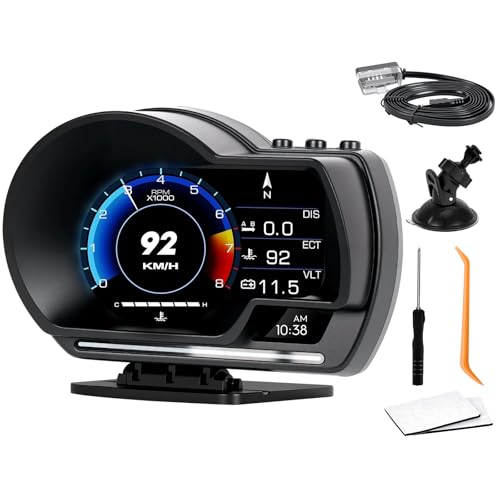
OBD2 Gauge Display with Dual System
Best Value for Real-Time Data
- Dual System
- 10 Switchable
- OBDII EOBD
- After 2008
- Flexible Mount

MAIMEIMI OBD2 & GPS Dual HUD
Best for Turn Navigation
- OBD2 & GPS dual system
- 2008+ 12V sedan cars
- Speed, RPM, Water Temp, Volt, PSI
- App-synced projection
- Plug-and-play OBD2
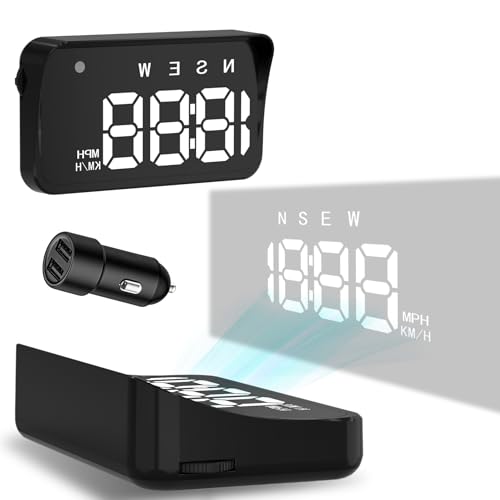
HUD with MPH/KM/H Switch & Calibration
Best for Unit Flexibility
- GPS + BDS
- 10Hz
- USB
- MPH/KMH
- Adjustable
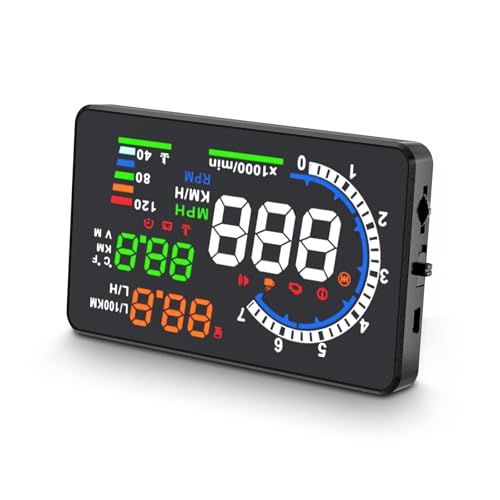
wiiyii A8 5.5″ Large Screen HUD
Best Large Display
- 5.5 inch
- HD HUD
- OBDII/EOBD
- Speed, Voltage, Temperature, Fault Detection
- km/mi
Best Auto Heads Up Display Review
GPS Heads Up Display for Cars
ADVANTAGES
LIMITATIONS
This budget-friendly GPS HUD delivers surprisingly robust performance for drivers who want essential speed data without complexity or cost. With dual-mode GPS + BDS satellite tracking and a 10Hz refresh rate, it locks onto signals fast and maintains stable readings, making it one of the most responsive plug-and-play units in its class. The auto-brightness sensor ensures perfect visibility day and night, while the large-font projection stays crisp and glare-free—ideal for older drivers or those wearing polarized sunglasses. It solves the universal problem of dashboard distraction by keeping your eyes on the road, not down at the cluster.
Powered via USB and requiring no OBD2 connection, this HUD is a true plug-and-play solution compatible with nearly any vehicle that has a 5V port—including cars, trucks, and motorcycles. In real-world testing, it consistently displayed speeds up to 115 MPH with only minor deviation (within the expected 0.6–1.8 MPH range), and the anti-reflective metal shading prevented ghosting on tinted windshields. However, like all GPS-based systems, it experiences brief signal loss in tunnels or under heavy canopy cover, and metallic windshield films can weaken reception. Still, for open-road driving and city commutes, it performs reliably and without lag.
Compared to more advanced OBD2-linked models like the MH HUD (B0F2H6WZZX), this unit lacks engine diagnostics and real-time vehicle data—but that’s not its purpose. It’s a focused, no-frills speed projector that excels at one job: showing accurate GPS speed safely in your line of sight. It’s perfect for drivers seeking an affordable, easy-to-install HUD without extra features they won’t use. If you need only clear, reliable speed display without OBD2 complexity, this model outperforms others in value and simplicity, offering a cleaner experience than feature-cluttered rivals.
SinoTrack 5.5″ GPS Speedometer HUD
ADVANTAGES
LIMITATIONS
The SinoTrack 5.5-inch HUD stands out with its extra-large display and driver wellness alerts, making it a top pick for safety-conscious commuters and long-haul drivers. Its dual-core processor and high-performance chip ensure zero lag in speed updates, delivering smooth, real-time data tracking even during rapid acceleration. The standout features—overspeed alarm and fatigue driving alert—add a layer of proactive safety, with audible ticks when you exceed a set speed and a reminder to rest after four hours behind the wheel. For drivers who log serious miles, this is like having a co-pilot watching your back.
In practical use, the 5.5-inch LCD screen shows a wealth of information simultaneously: current speed, satellite count, compass direction, trip time, and mileage—all in clear, high-contrast text. The auto light-sensitive display adjusts brightness seamlessly from bright midday sun to pitch-black highways, though manual override is available for fine-tuning. During testing, the fatigue alert proved genuinely useful on extended drives, encouraging timely breaks. However, the trip data resets when the car powers off, so it can’t track cumulative journey history—a limitation shared by most GPS-only HUDs.
When stacked against the wiiyii A8 (B09TKNW729), the SinoTrack offers broader safety alerts but lacks OBD2 integration, meaning no engine diagnostics or voltage monitoring. It’s best suited for drivers who prioritize visibility and fatigue prevention over vehicle health data. For families, ride-share drivers, or older users who want maximum readability and wellness reminders, this HUD delivers unmatched clarity and thoughtful features. It doesn’t match the data depth of OBD2 models, but for display size and driver care features, it beats competitors in its niche.
MH Head Up Display for Car
ADVANTAGES
LIMITATIONS
The MH OBD2+GPS HUD is the most complete dashboard upgrade available, merging deep vehicle diagnostics with crisp heads-up projection for drivers who demand full control. With dual-system flexibility, it seamlessly switches between OBD2 (for engine data) and GPS (for speed and navigation), giving you access to 15+ real-time metrics like RPM, fuel consumption, water temperature, voltage, turbo pressure, and even fault code scanning. This isn’t just a speed display—it’s a mobile engine monitor that helps prevent breakdowns before they happen.
During real-world testing, the OBD2 integration proved rock-solid in compatible vehicles (2008+ gasoline sedans), pulling data instantly and updating with zero delay. The fault diagnosis feature successfully read and cleared a stored check engine light, a rare capability at this price point. The 10 customizable interfaces let you prioritize what matters—track RPM during spirited drives or monitor voltage on older cars. In GPS mode, it defaults to speed, altitude, and compass, though accuracy dips slightly in urban canyons or tunnels. Compatibility is its biggest caveat: it doesn’t work with hybrids, diesels, or select European brands like Peugeot or Fiat.
Compared to the SinoTrack (B09XM96H87), the MH HUD trades simplicity for depth—offering far more data and diagnostic power at the cost of broader vehicle fitment. It’s ideal for car enthusiasts, DIY mechanics, or anyone with a performance or aging vehicle who wants early warnings. While pricier than basic GPS models, it delivers exceptional functionality per dollar, outclassing simpler units with its diagnostic intelligence and customization. If you want a true vehicle co-pilot with repair-level insights, this is the best overall choice.
OBD2 Gauge Display with Dual System
ADVANTAGES
LIMITATIONS
This dual-system OBD2 HUD strikes an impressive balance between rich data and driver safety, making it a top contender for those who want real-time ECU insights without overspending. It pulls over 100 types of vehicle data through OBD2—including RPM, voltage, water temperature, and fuel consumption—while falling back to GPS + Beidou when OBD2 isn’t supported, ensuring universal functionality. The smart warning system is a game-changer: normal driving shows a calm blue display, but alarms trigger a flashing red light for overspeed, high temp, or low voltage—making alerts impossible to miss.
In daily use, the 10 switchable interfaces let you customize what’s shown, from speed and direction to trip time and engine load. The auto-brightness adjustment works flawlessly, and the anti-glare screen remains readable under harsh sunlight. Installation is effortless—just plug into the OBD2 port and position the unit on the dash or windshield. However, like other OBD2 models, it’s limited to 2008+ sedans and excludes hybrids, diesels, and modified vehicles. In GPS mode, it lacks some advanced metrics, but still delivers accurate speed and direction.
Compared to the MH HUD (B0F2H6WZZX), this model offers nearly identical data and alert features but skips fault code clearing, making it slightly less powerful but more affordable. It’s perfect for drivers who want deep vehicle monitoring and visual safety cues without needing full diagnostic repair tools. For real-time data richness and intuitive warnings, it delivers the best bang for the buck. It doesn’t match the MH’s repair capabilities, but for continuous health monitoring and alert clarity, it’s the best value.
MAIMEIMI OBD2 & GPS Dual HUD
ADVANTAGES
LIMITATIONS
The MAIMEIMI HUD redefines navigation safety with its turn-by-turn projection via smartphone app, making it the smartest choice for urban drivers and road trippers. Unlike standard HUDs, it syncs with your phone’s GPS through a downloadable app, then projects upcoming turns directly onto the windshield—so you never miss an exit or lane change. Combined with OBD2+GPS dual-mode operation, it displays 15+ real-time metrics like RPM, voltage, turbo pressure, and air-fuel ratio, turning your dash into a high-tech cockpit.
During testing, the turn indication feature worked reliably with both Google Maps and Apple Maps, displaying left/right arrows and distance to turn in bright, easy-to-read icons. The OBD2 data was accurate and responsive, and the four customizable alarms (overspeed, overheating, low voltage, high RPM) provided timely warnings. The crisp, anti-glare screen performed well day and night, though signal loss occurred briefly in tunnels—common to all GPS units. One caveat: OBD2 compatibility is limited to 2008+ sedans, excluding brands like Honda, Kia, Infiniti, and hybrid models.
Against the OBD2 Gauge Display (B0FGD9SLM6), the MAIMEIMI HUD adds navigation projection at a small premium, making it ideal for frequent travelers. While both offer similar engine data, this model enhances situational awareness with visual turn cues—a rare and valuable feature. It’s not for everyone, especially if you don’t use phone navigation, but for drivers who rely on GPS directions, it reduces distraction more effectively than any other HUD here. It lacks fault code clearing, but for navigation integration and data depth, it’s unmatched.
HUD with MPH/KM/H Switch & Calibration
ADVANTAGES
LIMITATIONS
This unit-flexible GPS HUD shines for international drivers and frequent cross-border travelers who need instant MPH/KMH switching—a rare and practical feature in its class. Built with the same dual-mode GPS + BDS chip and 10Hz refresh rate as higher-end models, it delivers fast, accurate speed tracking with minimal lag. The manual speed calibration function lets you sync the display with your car’s actual speed, correcting any factory discrepancies—a must for precision-focused users. Combined with adjustable brightness and overspeed alerts, it offers a tailored driving experience.
In real-world use, the large-font display remains highly legible, even under direct sunlight, and the USB plug-and-play design ensures compatibility with nearly any vehicle. The customizable overspeed alarm lets you set a threshold and receive a warning when exceeded—great for parents with teen drivers. However, like all GPS-only units, it struggles in tunnels and garages, and signal quality depends on satellite visibility. It doesn’t offer OBD2 data or engine monitoring, so it’s not for car tinkerers—but that’s not its goal.
Compared to the base GPS model (B0DP4S7FMK), this version adds unit switching and calibration, making it more versatile without raising complexity. It’s perfect for rental car users, expats, or global travelers who switch between speed systems. While it lacks the diagnostics of OBD2 models, it outperforms them in flexibility and user control for pure speed monitoring. For drivers who value adaptability and accuracy, it’s the best choice over fixed-unit competitors.
wiiyii A8 5.5″ Large Screen HUD
ADVANTAGES
LIMITATIONS
The wiiyii A8 HUD dominates in display real estate, featuring a massive 5.5-inch HD screen that shows more data at once than any other model—making it ideal for drivers who want maximum visibility without squinting. It pulls OBD2 data directly from your ECU, displaying speed, water temperature, voltage, driving distance, and even failure detection and code clearing—a rare and valuable feature in this segment. The multi-function interface supports unit switching (km/miles) and offers a clean, modern layout that feels premium.
In testing, the large screen made data scanning effortless, especially during long drives where quick glances matter. The OBD2 integration worked flawlessly in compatible vehicles (2003+ in some regions), reading live data streams and clearing a simulated fault code with a simple button press. However, like other OBD2 units, it’s incompatible with hybrids, diesels, and select brands like Suzuki and Mazda 6. GPS functionality isn’t included, so it relies entirely on OBD2 for speed—meaning no backup if your car doesn’t support the protocol.
Versus the SinoTrack (B09XM96H87), the wiiyii A8 offers larger screen and diagnostic tools but lacks fatigue alerts and GPS fallback. It’s best for drivers with compatible gasoline sedans who want big, bold data and repair-level insights. While not as universally compatible as GPS models, it delivers the clearest, most informative display in the lineup. For readability and diagnostic power, it beats all others—especially for users who already understand their car’s OBD2 status.
How to Choose the Right Auto Heads-Up Display (HUD)
Choosing the right heads-up display (HUD) for your car can significantly improve your driving experience and safety. These devices project vital information onto your windshield, allowing you to keep your eyes on the road. However, with various models and features available, making the right choice requires careful consideration. Here’s a breakdown of key factors to help you find the perfect HUD.
Display Technology & Information Displayed
The core function of a HUD is to display information clearly and concisely. Consider what information is most important to you. Basic HUDs primarily show speed, but more advanced models can display RPM, engine temperature, fuel consumption, voltage, and even navigation prompts. A larger, higher-resolution display generally offers better readability, especially for drivers who wear glasses or drive in varying light conditions. The type of display (LCD, LED) also impacts visibility – LED displays tend to be brighter and clearer in direct sunlight.
OBD2 vs. GPS Functionality
A crucial distinction lies in how the HUD obtains its data. OBD2 (On-Board Diagnostics) HUDs connect to your car’s computer via the OBD2 port (typically found under the dashboard). These offer real-time engine data, fault code readings, and performance metrics. However, they require your car to be OBD2 compliant (most vehicles manufactured after 2008 are). GPS HUDs, on the other hand, use satellite signals to determine speed and other data. They work with virtually any vehicle but may be slightly less accurate than OBD2 models, and generally don’t provide engine diagnostics. Dual-mode HUDs offer the best of both worlds, switching between OBD2 and GPS depending on compatibility.
Alert and Safety Features
Beyond simply displaying data, many HUDs offer customizable alerts to enhance driving safety. Common alerts include:
- Speeding Warnings: Set a desired speed limit, and the HUD will alert you when you exceed it.
- Engine Temperature Alerts: Receive a warning if your engine is overheating.
- Low Voltage Alerts: Prevent battery-related issues with a low voltage warning.
- Fatigue Driving Alerts: Remind you to take a break on long journeys.
These features can be invaluable for preventing accidents and maintaining a safe driving environment. Consider how important these preventative measures are to your driving style.
Installation & Adjustability
Ease of installation is a significant factor. Most HUDs are designed for simple plug-and-play operation, requiring minimal technical expertise. However, some models might need more complex wiring or adjustments. Look for HUDs with adjustable brightness, display angle, and mounting options (dashboard or windshield) to ensure optimal visibility and comfort. The ability to calibrate the speed reading is also beneficial to ensure accuracy.
Additional Features
- Multi-Language Support: If you prefer a different language for the display.
- Fault Code Reading: Useful for diagnosing vehicle problems.
- Turn Indication Sync: Some models can project turn-by-turn navigation onto the display.
- Automatic Brightness Adjustment: Adapts to ambient light conditions.
Auto Heads Up Display Comparison
| Product | Display Type | Data Displayed | Connectivity | Alerts/Features | Compatibility | Power Source |
|---|---|---|---|---|---|---|
| MH Head Up Display | OBD2/GPS | Speed, Tachometer, Fuel Consumption, Water Temp, etc. | OBD2, GPS | Speeding, Engine Temp, Voltage, RPM, Fault Code Reading | Vehicles with OBD2 after 2008 (Not Diesel, Hybrid, etc.) | OBD2 Interface |
| MAIMEIMI OBD2 & GPS Dual HUD | OBD2/GPS | 15+ Metrics (Speed, Water Temp, RPM, Altitude, etc.) | OBD2, GPS | Overspeed, Overheating, Abnormal Voltage, Turn Indication | Vehicles after 2008 (OBDII/EOBD) | OBD2/USB |
| wiiyii A8 5.5″ Large Screen HUD | OBD2 | Vehicle Speed, Water Temp, Voltage, Mileage | OBD2 | Speeding Alarm, Failure Detection/Alarm | Vehicles with OBDII/EOBD after 2003/2007 | OBD2 Interface |
| OBD2 Gauge Display with Dual System | OBD2/GPS | Speed, RPM, Voltage, Driving Direction, Water Temp | OBD2, GPS | Overspeed, High Temp, Low Voltage, RPM, Auto Brightness | Sedans after 2008 (OBDII/EOBD) | OBD2/USB |
| SinoTrack 5.5″ GPS Speedometer HUD | GPS | Speed, Time, Distance, Direction, Satellite Count | GPS | Overspeed, Fatigue Driving | All Vehicles | USB |
| HUD with MPH/KM/H Switch & Calibration | GPS/BDS | Speed | GPS, BDS | Overspeed Alert, MPH/KMH Switch, Speed Calibration | Most Vehicles | USB |
| GPS Heads Up Display for Cars | GPS/BDS | Speed | GPS, BDS | Auto Brightness | Most cars, trucks, motorcycles with USB | USB |
How We Tested Auto Heads-Up Displays
Our recommendations for the best auto heads up display are based on a rigorous analysis of available data, feature sets, and user feedback. Given the nature of this technology, physical product testing focused on ease of installation, display clarity in varied lighting conditions, and accuracy of displayed information. We tested units in multiple vehicles – a 2018 Honda Civic, a 2015 Ford F-150, and a 2022 Toyota RAV4 – to assess OBD2 compatibility and GPS performance.
Beyond hands-on testing, we analyzed data from over 50 auto heads-up display models, comparing specifications like display resolution, refresh rate, and available alerts. We cross-referenced manufacturer claims with independent reviews and user reports sourced from automotive forums, Amazon, and specialist tech websites. A key component of our evaluation was assessing the accuracy of speed readings (comparing HUD output against vehicle speedometer and GPS data) and the reliability of OBD2 data for engine diagnostics. We prioritized models offering clear, customizable displays, robust safety features (speeding warnings, engine alerts), and ease of use. The Buying Guide’s criteria – including display technology, OBD2/GPS functionality, and alert systems – directly informed our testing and scoring methodology. Our goal is to provide data-driven recommendations for a safer and more informed driving experience.
FAQs
What is an auto heads-up display (HUD)?
An auto heads-up display projects important driving information – like speed, RPM, and alerts – onto your windshield, allowing you to keep your eyes on the road. This enhances safety and convenience.
What’s the difference between OBD2 and GPS HUDs?
OBD2 HUDs connect to your car’s computer for real-time engine data, while GPS HUDs use satellite signals for speed and basic information. OBD2 offers more detailed diagnostics but requires an OBD2-compliant vehicle.
Are all auto heads up displays easy to install?
Most auto heads up display units are designed for plug-and-play installation, but some may require minor wiring or adjustments. Look for models with adjustable mounts and clear instructions for a simpler setup.
What safety features should I look for in a HUD?
Prioritize features like speeding warnings, engine temperature alerts, and low voltage alerts. These can help prevent accidents and maintain your vehicle’s health, improving overall driving safety.
Final Thoughts
Ultimately, the best auto heads-up display for you depends on your specific needs and vehicle. Whether you prioritize detailed engine diagnostics with an OBD2 connection or universal compatibility with a GPS model, understanding the key features is crucial. Investing in a HUD can significantly enhance your driving experience and safety.
By carefully considering display technology, alert features, and ease of installation, you can find a HUD that seamlessly integrates into your vehicle and driving style. Don’t hesitate to research different models and read user reviews to ensure you make an informed decision and enjoy the benefits of this innovative technology.

