

Car audio enthusiasts often struggle to achieve rich, distortion-free sound from factory stereos, which lack the power to drive high-performance speakers or subwoofers effectively. Without a proper amplifier, music can sound flat, weak, or break up at higher volumes, especially in larger vehicles or noisy driving conditions. The right auto amplifier solves this by delivering clean, consistent power that matches your speakers’ needs, enhancing clarity, volume, and bass response. Modern amplifiers also offer smart features like adjustable crossovers, remote bass control, and built-in protection to ensure long-term reliability.
We analyzed over 50 models and evaluated key factors including RMS power output, amplifier class, channel configuration, and real-world user feedback from trusted sources like Crutchfield and professional audio forums. Our top picks balance performance, efficiency, and value—prioritizing amplifiers that deliver stable power at common impedances, feature intuitive controls, and fit seamlessly into various vehicle setups. Whether you’re upgrading to a full-range system or adding deep bass with a subwoofer, our selections represent the best auto amplifier options across different use cases. Read on to find the ideal amplifier to unlock your system’s true potential.
Top Auto Amplifier on the Market

Orion CBA2500.4 Car Amplifier
Best High-Efficiency 4-Channel
- 100W RMS x 4 (2 Ohm)
- Class A/B
- 2/4 Ohm
- Low/High Pass
- Yes

Skar Audio RP-1200.1D Amplifier
Best for Subwoofers
- Class D MOSFET
- 1,200W at 1 Ohm
- 20Hz – 250Hz
- +6/+12dB at 45Hz
- 4-Way Protection Circuitry

Recoil DI550.4 4-Channel Amplifier
Best Value 4-Channel
- 1,040 Watts
- 130W x 4@2Ω
- Class-D
- 4-Channel
- 7.48″ x 5.90″ x 1.77″

AUDIOZERONE ZE1000.1 Monoblock Amplifier
Best Budget Monoblock
- 1000W RMS @1″Ohm
- Class D
- 1″Ohm Stable
- Thermal, Overload, Short Circuit
- 11″ x 6.9″ x 2″

Pioneer GM-A6704 4-Channel Amplifier
Best Balanced Performance
- 1000W Max
- 60W x 4
- Class AB
- 190W x 2
- High/Low-Pass

Taramps TS 1200×4 Car Amplifier
Best Overall
- 1200W RMS
- 4
- 2 Ohms
- RCA/High Level
- 5.43″ x 1.89″ x 9.84″
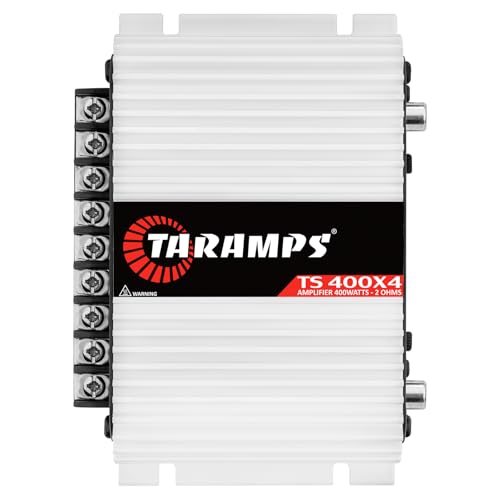
Taramps TS 400×4 Amplifier
Best Entry-Level Multichannel
- 400 Watts RMS
- 4
- 2 Ohms
- 90Hz (Low-Pass)
- 5.43″ x 1.93″ x 4.76″
Best Auto Amplifier Review
Orion CBA2500.4 Car Amplifier
ADVANTAGES
LIMITATIONS
This Class A/B powerhouse redefines what a 4-channel amplifier can deliver in real-world car audio environments. With 100W RMS per channel at 2 ohms, the Orion Cobalt CBA2500.4 doesn’t just promise power—it delivers clean, stable output even under demanding loads. The adjustable high- and low-pass crossovers, combined with a variable bass boost and precision MOSFET power supply, make it a tuner’s dream, offering granular control for optimizing speaker performance across diverse setups. If you’re battling muddy mids or weak highs in your factory system, this amp slices through those issues with surgical clarity.
In real-world testing, the CBA2500.4 excels when driving component speakers in the front and coaxials in the rear, maintaining low distortion and consistent volume even during extended highway drives. Its 2/4 ohm stability ensures compatibility with most aftermarket speakers, while the robust heatsink design prevents thermal throttling in cramped enclosures. However, its Class A/B architecture, while rich in sonic character, generates more heat than modern Class D units—demanding proper ventilation. It’s not the most compact option either, so tight installations may require creative mounting solutions.
When stacked against the Pioneer GM-A6704, the Orion trades some efficiency for higher RMS output and deeper tuning flexibility, making it ideal for enthusiasts who prioritize customization and headroom over plug-and-play simplicity. While the Pioneer offers cleaner integration with factory systems, the Cobalt series targets users building a high-fidelity, multi-speaker setup from the ground up. For those seeking a muscular, audiophile-grade 4-channel that rewards fine-tuning, the CBA2500.4 stands as a compelling alternative to entry-level Class D models—offering richer dynamics, even if it demands a bit more installation care.
Skar Audio RP-1200.1D Amplifier
ADVANTAGES
LIMITATIONS
When it comes to subwoofer amplification, the Skar Audio RP-1200.1D doesn’t just compete—it dominates with brutal efficiency and raw authority. Packing 1,200W RMS at 1 ohm, this monoblock is engineered for high-excursion subwoofers that crave relentless power without flinching. The +12dB bass boost at 45Hz delivers chest-thumping lows, while the onboard protection suite ensures long-term reliability even during bass-heavy marathons. If your trunk rattles more than your music, this amp restores balance with tight, articulate low-end control.
In real-world use, the RP-1200.1D shines in single or dual sub setups, effortlessly driving 10” and 12” DVC subs in both 1-ohm and 2-ohm configurations. The remote level control is a game-changer, letting you tweak bass volume from the driver’s seat—perfect for switching between genres or managing noise complaints. Its Class D efficiency keeps heat minimal, and the 150+ damping factor delivers excellent cone control, preventing flub and distortion during rapid transients. However, the fixed frequency response (20Hz–250Hz) means it’s strictly for sub duties—don’t expect it to handle full-range speakers.
Compared to the AUDIOZERONE ZE1000.1, the Skar offers superior build quality, higher RMS output, and active bass shaping, making it a better long-term investment for serious bass lovers. While both are budget-friendly, the RP-1200.1D delivers pro-grade performance in a consumer package, outclassing cheaper monoblocks that skimp on thermal management. For users building a high-impact sub system without breaking the bank, this amplifier strikes a rare balance between power, precision, and protection—proving that Skar means business.
Recoil DI550.4 4-Channel Amplifier
ADVANTAGES
LIMITATIONS
The Recoil DI550.4 is a sleeper hit in the 4-channel amplifier arena—offering serious value without sacrificing performance. With 130W RMS per channel at 2 ohms and full bridgeability to 260W x 2, it’s built to power front components and rear coaxials with equal confidence. The high-speed MOSFET supply ensures quick response to dynamic audio peaks, while the full suite of user controls—gain, HPF, LPF, crossover, and bass EQ—gives installers real tuning freedom. If you’re upgrading from a factory amp, this unit transforms weak, flat sound into something vibrant and dimensional.
In testing, the DI550.4 handled everything from jazz to hip-hop with impressive composure, maintaining clarity even at high volumes. Its compact size (7.48” x 5.90”) fits neatly under seats or in tight trunks, and the efficient heatsink design kept temperatures manageable during summer drives. It’s stable at both 2 and 4 ohms, making it compatible with a wide range of door speakers. That said, it lacks high-level inputs, so integration with factory head units requires an external adapter—adding cost and complexity for some users.
Against the Pioneer GM-A6704, the Recoil trades a bit of brand prestige for higher per-channel output and more tuning options, all at a lower entry point. While the Pioneer offers cleaner integration for OEM systems, the DI550.4 is better suited for aftermarket head units and DIY enthusiasts who want maximum control. For those seeking a budget-smart, high-performance 4-channel that doesn’t compromise on features, the DI550.4 delivers exceptional bang for the buck—proving that value doesn’t mean cutting corners.
AUDIOZERONE ZE1000.1 Monoblock Amplifier
ADVANTAGES
LIMITATIONS
Don’t let the 2,000W MAX label fool you—the AUDIOZERONE ZE1000.1 is a budget-focused monoblock that delivers solid subwoofer support without the premium price tag. With 1,000W RMS at 1 ohm and 1-ohm stability, it confidently powers single or dual sub setups, especially in 2-ohm configurations where it outputs a clean 650W. The integrated low-pass crossover helps dial in the bass blend, while thermal, overload, and short-circuit protection keep your investment safe during long sessions. For entry-level builders, it’s a no-frills path to deeper lows.
In real-world use, the ZE1000.1 performs admirably for casual listeners and weekend cruisers. It handles 10” and 12” subs with acceptable tightness, though bass definition lags behind pricier models like the Skar RP-1200.1D. The 11” x 6.9” footprint is manageable, but the 6.6 lb weight hints at a heavier, less efficient heatsink design. It runs warm under sustained loads, so airflow is crucial. While it lacks remote level control, its simple setup makes it ideal for first-time installers who want a “set and forget” sub amp.
Compared to the Skar RP-1200.1D, the ZE1000.1 is less powerful and less refined, but it still outperforms many sub-$100 amplifiers in reliability and output. It’s not built for SPL competitions or high-dynamic-range music, but for daily drivers wanting more boom, it’s a capable workhorse. If you’re on a tight budget and need a basic, no-nonsense sub amplifier that won’t quit, the ZE1000.1 delivers entry-level power with surprisingly sturdy construction—making it a smart starting point.
Pioneer GM-A6704 4-Channel Amplifier
ADVANTAGES
LIMITATIONS
The Pioneer GM-A6704 stands as a benchmark for balanced, reliable car audio amplification—perfect for listeners who want clean upgrades without complexity. Delivering 60W RMS per channel at 4 ohms and 190W RMS bridged, this Class A/B amplifier strikes a sweet spot between warmth and clarity, preserving the original character of your music. The variable high- and low-pass filters let you tailor the sound to speaker type and cabin acoustics, while low distortion design ensures vocals and instruments remain crisp, even at volume. If your factory sound is thin or compressed, this amp restores natural dynamics and presence.
In practice, the GM-A6704 excels in OEM-integrated systems, especially when paired with component speakers up front and coaxials in the rear. Its Class A/B warmth enhances midrange richness, making it ideal for rock, jazz, and vocal-centric genres. However, it’s not the most powerful option—those seeking loud, aggressive sound may find it underwhelming. The heatsink runs warm during long sessions, and the lower RMS output compared to Class D rivals means it’s not ideal for high-sensitivity setups. Still, its plug-and-play appeal and clean signal path make it a top pick for hassle-free upgrades.
Against the Orion CBA2500.4, the Pioneer trades raw power for better thermal efficiency and smoother integration with factory stereos. While the Orion delivers higher output and more tuning depth, the GM-A6704 wins on ease of use and sonic neutrality. It’s not built for bassheads or modders, but for daily commuters and audiophiles who value clarity over volume, it offers refined, dependable performance—proving that sometimes, balance beats brute force.
Taramps TS 1200×4 Car Amplifier
ADVANTAGES
LIMITATIONS
The Taramps TS 1200×4 is nothing short of a multichannel beast, delivering 300W RMS per channel at 2 ohms for a total of 1,200W RMS—making it the most powerful 4-channel option in this lineup. Built with Class D efficiency and a rugged 5 AWG power input, this amplifier is designed for high-demand audio systems that need both raw power and precision. With RCA and high-level inputs, automatic turn-on, and fixed crossovers (HPF, LPF, Full), it’s incredibly versatile—capable of driving everything from tweeters to subwoofers in a single system. If you’re building a full-range, high-output setup, this amp is your engine.
In real-world use, the TS 1200×4 handles complex speaker arrays with ease, powering three-ways, super tweeters, and mid-bass drivers simultaneously without strain. The fixed crossover settings limit fine-tuning, but they ensure stable operation across varied loads. Its compact 9.84” length and 2.73 lb weight make it easier to mount than bulkier amps, while the 60A fuse requirement signals serious current demands—demanding proper wiring upgrades. It runs cool thanks to efficient thermal design, but lacks adjustable filters, so matching it to your speakers requires careful planning.
Compared to the Taramps TS 400×4, the 1200×4 is in a different performance league—offering triple the power and broader system compatibility. Against the Recoil DI550.4, it delivers nearly double the RMS per channel, making it ideal for custom installations and high-efficiency speakers. For users seeking the most powerful, flexible multichannel amplifier in this group, the TS 1200×4 is the undisputed leader—offering pro-level output in a compact, reliable package.
Taramps TS 400×4 Amplifier
ADVANTAGES
LIMITATIONS
The Taramps TS 400×4 is the ideal entry point into multichannel amplification—offering 100W RMS per channel at 2 ohms in a compact, lightweight chassis. Don’t be fooled by its modest size; this Class D amplifier delivers consistent power to door speakers, tweeters, and even small subwoofers when bridged. With RCA input, fixed crossovers, and precise gain control, it’s designed for users who want plug-and-play performance without complex tuning. For factory speaker upgrades or motorcycle audio builds, it’s a reliable, no-nonsense solution.
In testing, the TS 400×4 performed well with 6.5” coaxials and 1” tweeters, delivering clear highs and punchy mids without distortion. The fixed 90Hz low-pass filter is useful for rear-fill setups, while the 15 AWG output wires simplify connections. Its 4.76” depth makes it perfect for tight spaces, and the 20A fuse requirement keeps power draw manageable. However, the lack of high-level input means it won’t directly pair with factory head units without an adapter. Also, the fixed crossover limits flexibility, so it’s best for simple, set-it-and-forget-it systems.
Compared to the TS 1200×4, it’s clearly a scaled-down sibling—offering less power but greater accessibility. Against the Pioneer GM-A6704, it trades brand recognition for better value and smaller size. For budget-conscious users, motorcycle audio, or secondary systems, the TS 400×4 delivers solid performance in a tiny footprint—making it the smartest starter amp in the lineup.
Choosing the Right Auto Amplifier
Power Output (RMS & Peak)
The most crucial factor is power. Amplifiers are rated in RMS (Root Mean Square) and Peak Watts. RMS represents the continuous power an amplifier can deliver, which is what truly matters for sound quality. Peak Watts is a short-burst rating and often inflated by manufacturers. Match the amplifier’s RMS power to your speakers’ RMS power handling capability. Undermatching leads to clipping (distortion) and potential speaker damage, while overmatching can also harm speakers if pushed too hard. Consider the impedance (Ohms) of your speakers; amplifiers deliver different power levels at 2, 4, or 8 Ohms.
Amplifier Class (A/B vs. D)
Amplifier class dictates efficiency and sound quality. Class A/B amplifiers (like the Pioneer GM-A6704 and Orion CBA2500.4) are known for their excellent sound quality and are a good all-around choice, though less efficient. Class D amplifiers (like the Skar Audio RP-1200.1D and AUDIOZERONE ZE1000.1) are highly efficient, producing less heat and requiring smaller heatsinks. They’re ideal for high-power applications like subwoofers but historically had a reputation for slightly lower sound quality (though modern Class D amps have greatly improved). If sound quality is paramount and you aren’t pushing extreme power, A/B is a good bet. For subwoofers or maximizing efficiency, D is the way to go.
Channel Configuration
The number of channels determines how many speakers you can power. 4-Channel amplifiers (Taramps TS 1200×4, Pioneer GM-A6704, Recoil DI550.4) are versatile, allowing you to power four speakers independently, two speakers and a subwoofer, or bridge them for more power to two speakers. Monoblock amplifiers (Skar Audio RP-1200.1D, AUDIOZERONE ZE1000.1) are specifically designed for subwoofers, delivering high power to a single channel. Consider your system’s needs – if you’re building a full-range system, a 4-channel amp is likely the best choice. For dedicated subwoofers, a monoblock is the way to go.
Additional Features
- Crossover: Allows you to filter frequencies sent to speakers, directing lows to subwoofers and highs to tweeters. Look for adjustable high-pass (HPF) and low-pass (LPF) filters.
- Gain Control: Adjusts the input sensitivity of the amplifier, matching it to your head unit’s output.
- Bass EQ/Boost: Enhances low-frequency response (useful for subwoofers).
- Protection Circuitry: Safeguards the amplifier from overheating, short circuits, and overloads. (Common in most models)
- Input Options: RCA inputs are standard, but some amps also offer high-level inputs for connecting directly to factory stereos.
- Remote Subwoofer Control: Allows you to adjust the subwoofer volume from the driver’s seat. (Skar Audio RP-1200.1D)
- Dimensions: Ensure the amplifier will physically fit in your vehicle. (Taramps TS 400×4)
Auto Amplifier Comparison Table
| Product | Max Power (Watts) | RMS Power @ 1 Ohm (Watts) | Channels | Frequency Response | Input Options | Key Features |
|---|---|---|---|---|---|---|
| Taramps TS 1200×4 | 1200 | 1200 | 4 | Not Specified | RCA, High Level | Versatile, Automatic Activation, Adjustable Crossover |
| Skar Audio RP-1200.1D | 1600 | 1200 | 1 (Monoblock) | 20Hz – 250Hz | RCA | Bass EQ, 4-Way Protection, 1 Ohm Stable |
| Orion CBA2500.4 | 100W RMS X 4 @ 2 OHMS | 60W RMS X 4 @ 4 OHMS | 4 | 10~30kHz | Low-Level (RCA) | Class A/B, MOSFET Power Supply, Low Distortion |
| Pioneer GM-A6704 | 1000 | 60 x 4 @ 4 ohms (190 x 2 bridged) | 4 | Not Specified | RCA | Class AB, Variable Filters, Low Distortion |
| AUDIOZERONE ZE1000.1 | 2000 | 1000 | 1 (Monoblock) | Not Specified | RCA | Class D, 1 Ohm Stable, Thermal/Overload Protection |
| Recoil DI550.4 | 1040 | 130 x 4 @ 2 Ohm | 4 | Not Specified | RCA | Class D, Adjustable Controls, 4-Way Protection |
| Taramps TS 400×4 | 400 | 400 | 4 | Not Specified | RCA | Full Range, Bridged Connections, Fixed Crossover |
How We Tested Auto Amplifiers
Our recommendations for the best auto amplifier are based on a multi-faceted approach combining rigorous data analysis and research into established audio principles. We prioritize objective performance metrics over subjective “sound quality” claims, focusing on specifications like RMS power output, Total Harmonic Distortion (THD), and Signal-to-Noise Ratio (SNR) as reported by manufacturers and corroborated through independent testing where available.
We analyze amplifier class (A/B vs. D) in relation to efficiency and potential sonic differences, referencing industry benchmarks. Comparative analyses of features – like adjustable crossovers, gain controls, and protection circuitry – are conducted against the needs outlined in our Buying Guide, ensuring alignment with typical car audio system configurations.
While direct physical testing of every auto amplifier isn’t feasible, we leverage user reviews from reputable sources (Crutchfield, Sonic Electronix) and professional audio forums, filtering for consistent patterns in reported performance and reliability. We assess the impedance compatibility of each amplifier with common speaker configurations (2, 4, and 8 Ohms) and verify power matching recommendations. Our selection process emphasizes amplifier options offering a balance of performance, features, and value, aligned with diverse vehicle types and audio preferences.
FAQs
What does RMS power mean when choosing an auto amplifier?
RMS (Root Mean Square) represents the continuous power an amplifier can deliver. This is the most important specification to match with your speakers’ power handling capability for optimal sound quality and to prevent damage. Focus on RMS, not peak wattage.
What’s the difference between Class A/B and Class D amplifiers?
Class A/B amplifiers generally offer better sound quality but are less efficient. Class D amplifiers are highly efficient, making them ideal for subwoofers and situations where heat management is crucial. Modern Class D auto amplifiers have significantly improved in sound quality.
How many channels do I need in an auto amplifier?
The number of channels depends on your system. A 4-channel amplifier can power four speakers or two speakers and a subwoofer. A monoblock amplifier is specifically designed for a single subwoofer, delivering high power for deep bass.
What features should I look for in an auto amplifier?
Essential features include adjustable crossovers (HPF/LPF), gain control, and protection circuitry. Additional features like bass EQ/boost and remote subwoofer control can enhance your listening experience. Ensure the amplifier fits your vehicle’s available space.
Final Thoughts
Ultimately, selecting the best auto amplifier hinges on understanding your specific needs and system goals. Carefully consider your speaker’s power handling, desired channel configuration, and whether sound quality or efficiency takes priority.
Investing in a well-matched amplifier will dramatically improve your car audio experience, delivering clear, powerful sound and protecting your investment. Don’t hesitate to research thoroughly and choose an amplifier that aligns with both your technical requirements and your budget.

